
The Overlooked Dimension of Longevity: Why Memories, Meaning and Human Connection Matter
For decades, the longevity conversation has been dominated by metrics, biomarkers, supplements, exercise protocols, and increasingly sophisticated medical interventions. We measure biological age, track sleep scores, monitor glucose spikes, and optimize every aspect of physical performance.
Yet one of the most powerful predictors of healthy aging remains remarkably simple: the quality of our relationships, our sense of purpose, and the stories that give meaning to our lives.
The future of longevity may not be found exclusively in laboratories. It may also be found around family tables, within treasured heirlooms, and in the memories that connect generations.
Longevity Is More Than Lifespan
Modern longevity science has evolved beyond the pursuit of simply living longer. Today, experts distinguish between lifespan and healthspan.
Lifespan refers to the total number of years lived.
Healthspan refers to the years lived in good physical, mental, emotional, and social health.
This distinction is crucial because adding years without preserving quality of life has limited value. The ultimate goal is not merely to extend existence, but to extend vitality, purpose, and fulfillment.
Increasingly, research suggests that social and emotional well-being are not peripheral to this goal. They are fundamental components of it.
The World Health Organization recently highlighted social connection as a critical public health priority, describing social health as a key pillar of overall well-being. According to the WHO Commission on Social Connection, approximately one in six people worldwide experiences loneliness, while social isolation and loneliness have measurable impacts on health, well-being, and longevity. turn6search5
In other words, human connection is not simply a pleasant addition to life. It is a heath factor.
The Science of Meaning
One of the most fascinating areas of longevity research focuses on purpose.
A systematic review published in the International Journal of Environmental Research and Public Health describes purpose in life as a significant contributor to healthy aging. Researchers found that purpose is closely associated with well-being, social relationships, personal resilience, and positive health outcomes. turn6search8
Even more remarkably, a longitudinal study published in Psychological Science found tat individuals with a stronger sense of purpose experienced lower mortality risk over time. Researchers concluded that having a meaningful sense of direction in life appears to contribute to longevity across adulthood. turn6search10
What does purpose have to do with memories?
Everything.
Our memories form the narratve framework through which purpose emerges. They remind us who we are, what we value, where we come from, and what we hope to leave behind.
When a person reflects on a meaningful life event, a family tradition, or a cherished relationship, they are not simply revisiting the past. They are reinforcing identity and reaffirming meaning.
The World’s Longest Happiness Study Reached a Simple Conclusion
Few research projects are as respected as the Harvard Study of Adult Development, one of the longest-running studies on human well-being.
After following participants across multiple decades, researchers repeatedly arrived at the same conclusion: strong and meaningful relationships are among the most important predictors of health, happiness, and healthy aging. People who are more socially connected tend to be healthier and longer-lived than those who are isolated. turn6search15
Robert Waldinger, the study’s current director, summarized the findings succinctly: wht keeps people healthier and happier throughout life is not wealth, status, or achievement, but the quality of their connections with others. turn6search15
This insight feels particularly relevant in an age obsessed with optimization.
We areinvesting enormous effort in extending our years while often neglecting the relationships that make those years worth living.
Why Remembering Matters
Psychologists have long understood that reminiscing serves a deeper purpose than nostalgia.
Structured reminiscence and life-review practices are increasingly used in therapeutic settings because they have been shown to support emotional well-being, strengthen identity, encourage social engagement, and improve quality of life among older adults. turn6search24
When individuals revisit meaningful experiences, they reconnect with accomplishments, elationships, values, and moments of resilience.
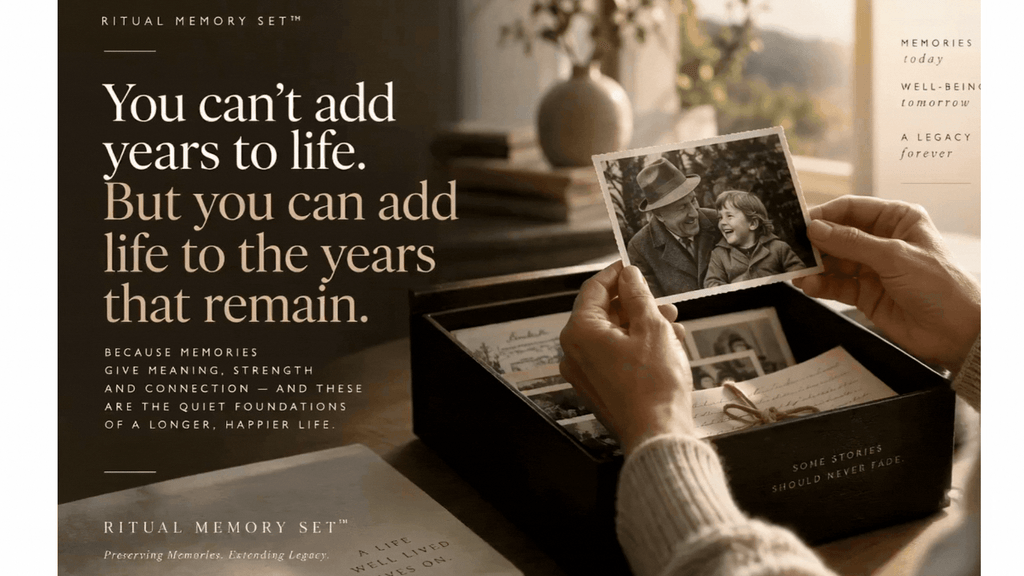
A photograph becomes more than an image.
A letter becomes more than paper.
A family heirloom becomes more than an object.
Each serves as a gateway to identity.
In a world of constant digital acceleration, remembering becomes an act of grounding.
The Hospitality Industry Has a Unique Opportunity
For decades, luxury hospitality focused on comfort and service.
Today, the most forward-thinking hospitality brands are moving toward something deeper: creating meaningful experiences that become lasting memories.
Guests no longer seek merely accommodation or amenities.
They seek experiences worth remembering.
A growing body of evidence suggests that experiences generate longer-lasting happiness than material possessions because they strengthen personal narratives and social bonds. While a luxury object may eventually be forgotten, a meaningful experience often becomes part of an individual’s life story.
This shift creates an entirely new opportunity for hospitality.
Properties, retreats, wellness destinations, and luxury brands can position themselves not merely as providers of experiences, but as custodians of memory.
If longevity increasingly includes emotional, social, and psychological well-being, then the experiences we preserve may hold greater value than the possessions we acquire.
A New Definition of Legacy
Perhaps the greatest misunderstanding about legacy is the assumption that it is primarily financial.
Yet when families gather across generations, what endures are rarely balance sheets.
What endures are stories.
The photograph that everyone recognizes.
The handwritten note that still brings tears.
The object passed from one generation to the next.
The memory retold around a table decades later.
These are the assets that continue to create meaning long after material achievements have faded.
And perhaps this is where the conversation about longevity ultimately leads.
Not simply to living longer.
But to ensuring that what matters most continues to live beyond us.
Because true longevity is not measured only by the number of years we accumulate.
It is measured by the meaning we create, the connections we nurture, and the memories that continue to shape lives long after our own story has been written.